Hair Loss Is More Than Just a Hair Problem
Seeing extra hair on your pillow, in the shower drain, or on your comb can be worrying. The concern becomes greater when your hairline starts looking thinner or your scalp becomes more visible.
For many people, finding the right Hair Loss Treatment in Mumbai isn’t simply about choosing the most popular procedure. The better approach is to understand why you’re losing hair and whether the problem is temporary, progressive, hormonal, nutritional, or related to the hair follicles themselves.
PRP, GFC and Mesotherapy are commonly discussed options for hair thinning and hair fall. However, they don’t work in exactly the same way.
The right choice depends on factors such as your type of hair loss, follicle health, age, medical history, nutritional status, and treatment goals.
This guide compares the three treatments in simple terms so you can make a more informed decision.
What Causes Hair Loss and Hair Thinning?
Hair fall can have many causes. Sometimes the trigger is temporary. In other cases, hair loss continues unless the underlying problem is addressed.
Common causes include:
- Genetic or hereditary hair loss
- Male pattern hair loss
- Female pattern hair thinning
- Hormonal changes
- PCOS-related hair concerns
- Thyroid disorders
- Iron or vitamin deficiencies
- Rapid weight loss
- Severe stress
- Poor sleep
- Recent illness or infection
- Post-pregnancy hair shedding
- Certain medications
- Scalp infections
- Dandruff and scalp inflammation
- Excessive chemical treatments
- Frequent heat styling
- Tight hairstyles
- Poor nutrition
For example, someone who suddenly develops hair shedding after a stressful period may need a very different approach from someone who has experienced gradual thinning around the crown for several years.
That’s why treatment should start with an assessment rather than simply choosing a procedure.
When Should You Seek Hair Loss Treatment?
A few hairs falling during washing is normal. Hair growth naturally follows a cycle that includes growth, transition and resting phases.
The concern starts when shedding becomes noticeably higher or your hair density keeps decreasing.
Watch for signs such as:
- A widening centre part
- Receding hairline
- Visible scalp
- Thinning around the crown
- Smaller ponytail volume
- Increased hair on your pillow
- Excessive shedding while washing
- Hair becoming finer over time
- New bald patches
- Slower-looking hair growth
- Reduced density compared with previous years
If hair loss continues for several months, don’t keep changing shampoos and oils without finding the cause.
Early evaluation can help determine whether follicles are still active and what type of treatment may be appropriate.
PRP Hair Treatment: How Does It Work?
PRP stands for Platelet-Rich Plasma.
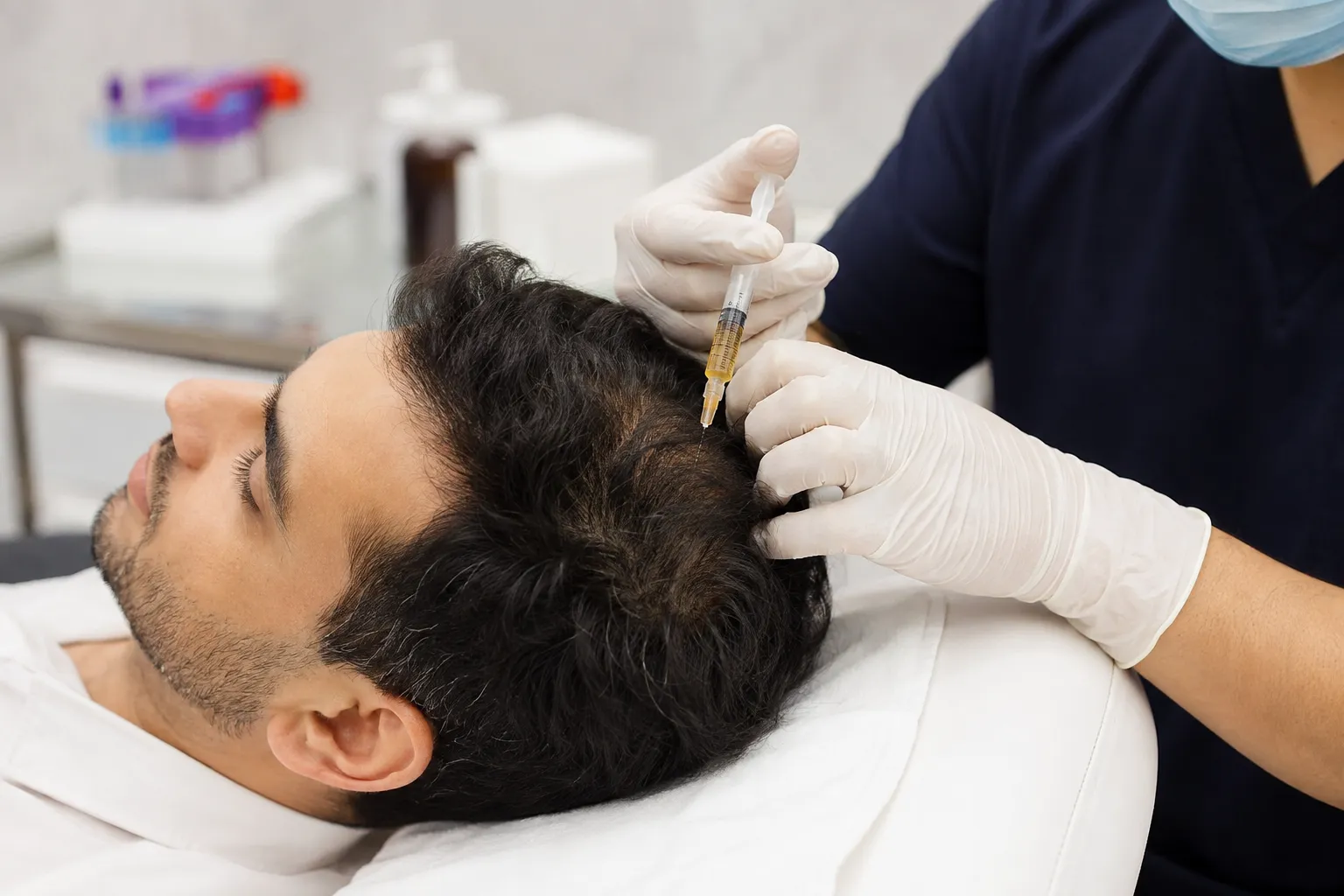
The treatment uses a small amount of your own blood. The sample is processed to separate platelet-rich plasma, which is then applied or injected into selected areas of the scalp.
Platelets contain growth-related substances that may support the follicular environment.
PRP is generally considered when the goal is to improve the health of existing follicles and support hair density.
It is not the same as a hair transplant.
A transplant moves hair follicles from one area to another. PRP does not create new follicles where none exist.
Potential benefits of PRP
PRP may be considered for people experiencing:
- Early-stage hair thinning
- Pattern hair loss
- Reduced hair density
- Weak or miniaturised hair
- Increased shedding
- Poor follicle activity
Results vary between individuals. Some people notice reduced shedding before seeing an improvement in density.
How long does PRP take?
A session usually involves consultation, preparation, blood collection, processing and scalp treatment.
The exact duration depends on the protocol followed by the clinic.
Most treatment plans involve multiple sessions rather than one appointment.
GFC Hair Treatment: What Makes It Different?
GFC stands for Growth Factor Concentrate.
Like PRP, GFC is designed to use growth-related components derived from the patient’s own blood. The preparation process and concentration of growth factors differ from conventional PRP protocols.
The objective is to support the scalp environment and existing hair follicles.
GFC is often discussed by people looking for a more targeted regenerative approach to hair thinning.
Potential advantages of GFC
Depending on the individual case and treatment protocol, GFC may be considered for:
- Hair thinning
- Early pattern hair loss
- Reduced hair density
- Weak-looking hair
- Follicle support
- Hair regrowth programs
However, GFC shouldn’t automatically be considered “better” for everyone.
Treatment selection should be based on diagnosis and follicular status rather than marketing claims.
A person with advanced baldness may not achieve meaningful coverage from injections alone. A different treatment plan may be required.
Mesotherapy for Hair Loss: Is It Effective?
Mesotherapy involves delivering selected substances into the skin using multiple small injections.
For hair concerns, the formulation can vary between clinics and treatment protocols.
Depending on the approach, ingredients may be selected to support scalp and follicle health.
The important point is that Mesotherapy isn’t one single standardized treatment.
The substances used, concentration, technique and treatment schedule can differ.
Therefore, when someone asks whether Mesotherapy is the best treatment for hair loss, the answer depends on what is being treated and what formulation is being used.
Who may consider Mesotherapy?
It may be discussed for people with:
- Diffuse hair thinning
- Weak hair
- Early hair fall
- Scalp concerns affecting hair quality
- Hair density concerns
A proper scalp assessment is important before starting treatment.
PRP vs GFC vs Mesotherapy: Which Is Better?
There isn’t one treatment that is automatically best for every person.
The three approaches differ in preparation, technique and treatment goals.
| Feature | PRP | GFC | Mesotherapy |
|---|---|---|---|
| Basic approach | Platelet-rich plasma | Growth factor concentrate | Scalp injections with selected formulation |
| Source | Patient’s blood | Patient’s blood | Depends on formulation |
| Main objective | Support follicle environment | Growth-factor-based follicular support | Deliver selected substances to scalp |
| Common use | Hair thinning and early hair loss | Hair thinning and follicular support | Hair fall and scalp-focused treatment |
| Sessions | Usually multiple | Usually multiple | Usually multiple |
| Downtime | Usually minimal | Usually minimal | Usually minimal |
| Results | Vary by individual | Vary by individual | Vary by individual |
| Suitable for everyone? | No | No | No |
The choice shouldn’t be based only on the name of the procedure.
For example, if your follicles are still active but producing increasingly fine hair, regenerative treatments may be discussed.
If you have advanced baldness with little usable follicular activity in an area, injections may have limitations.
Which Treatment Is Suitable for Men and Women?
Hair loss affects both men and women, but the pattern can be different.
Hair loss treatment for men
Men commonly experience recession around the temples and thinning at the crown.
This pattern may progress gradually because of genetic and hormonal factors.
Treatment may focus on preserving existing follicles, improving hair density and slowing further progression.
Hair loss treatment for women
Women may experience diffuse thinning across the scalp.
The centre part may become wider while the hairline remains relatively intact.
Possible contributors include:
- Hormonal changes
- PCOS
- Thyroid problems
- Iron deficiency
- Stress
- Pregnancy
- Menopause
- Nutritional deficiencies
A woman experiencing sudden or significant shedding should not assume that a cosmetic procedure alone will solve the problem.
Finding the trigger matters.
What Happens During a Hair Loss Treatment Session?
The exact process depends on whether you choose PRP, GFC or Mesotherapy.
A typical appointment starts with an assessment of your scalp and hair density.
The clinician may discuss:
- Your hair-loss history
- Duration and pattern of shedding
- Previous treatments
- Medical and lifestyle factors
- Scalp condition
- Hair density and follicle status
- Your treatment expectations
If an injectable treatment is considered appropriate, the scalp is prepared before the procedure.
For PRP or GFC, a blood sample may be collected and processed according to the treatment protocol.
For Mesotherapy, the selected formulation is delivered into the scalp using multiple small injections.
You may experience mild discomfort, redness, tenderness or swelling after treatment.
These effects are usually temporary, but individual experiences vary.
How Many Sessions Do You Need?
There is no universal number of sessions.
Your treatment plan depends on:
- Severity of hair loss
- Type of hair loss
- Follicle condition
- Age
- Treatment response
- Underlying causes
- Previous treatments
Some people may need an initial series followed by maintenance sessions.
It’s also important to understand that hair grows slowly.
A treatment shouldn’t be judged after only a few days.
Taking baseline photographs can be useful. Try to photograph the front, sides, crown and centre part under similar lighting.
This makes gradual changes easier to notice.
When Can You Expect Hair Regrowth?
This is one of the most common questions people ask.
Hair doesn’t normally become visibly thicker immediately after an injection treatment.
The follicle needs time to move through its natural growth cycle.
You may first notice changes in shedding or hair texture. Visible density improvements can take longer.
Your response can depend on:
- Cause of hair loss
- Duration of the condition
- Follicle activity
- Age
- Nutrition
- Hormonal health
- Consistency with treatment
- Overall scalp health
Be cautious about clinics promising dramatic regrowth within a few weeks.
A realistic treatment plan should explain what can reasonably be expected.
Hair Loss Treatment Cost in Mumbai
The price of treatment can vary widely between clinics.
There isn’t one fixed price for PRP, GFC or Mesotherapy because several factors affect the final cost.
These include:
- Type of treatment
- Number of sessions
- Treatment area
- Severity of hair loss
- Products or preparation used
- Clinic facilities
- Expertise of the treating professional
- Whether maintenance sessions are recommended
Instead of choosing a clinic only because it offers the lowest price, ask what the quoted amount includes.
You should also ask whether consultation, preparation and follow-up are included.
A cheaper package isn’t necessarily the better option if the treatment plan isn’t suitable for your condition.
Are There Any Side Effects?
Hair injection procedures can cause temporary effects.
These may include:
- Mild pain
- Tenderness
- Redness
- Swelling
- Small injection marks
- Temporary scalp sensitivity
- Bruising in some cases
The risk depends on the procedure, technique and individual factors.
Before treatment, tell the clinician about your medications, allergies, bleeding problems and existing medical conditions.
You should also follow the aftercare instructions provided by the clinic.
If you experience unusual or persistent symptoms after a procedure, contact the treating clinic for advice.
Can Hair Loss Treatment Stop Hair Fall Permanently?
This is where expectations matter.
There is no single injection that guarantees permanent protection from every form of hair loss.
If the underlying cause continues, hair thinning may continue too.
For example, hereditary hair loss can be progressive. Nutritional deficiencies need to be corrected. Hormonal conditions may require appropriate medical management.
Hair treatment works best as part of a broader plan when necessary.
This may include scalp care, nutrition, lifestyle changes, medical treatment and procedures.
Common Mistakes People Make When Treating Hair Loss
1. Waiting until hair loss becomes severe
Early thinning is easier to address than advanced follicular loss.
2. Choosing treatment based only on price
Cost matters, but suitability and safety matter more.
3. Comparing results with someone else
Two people can receive the same treatment and have completely different outcomes.
4. Expecting instant results
Hair growth takes time.
5. Ignoring nutrition
Low iron, inadequate protein intake and certain nutritional deficiencies can contribute to hair problems.
6. Changing treatments too quickly
Switching from one treatment to another every few weeks makes it difficult to assess what is working.
7. Believing every online claim
Before-and-after photographs can be useful, but lighting, hair length and styling can change how results appear.
What Should You Check Before Choosing a Clinic?
Choosing a clinic is an important part of your treatment journey.
Look for a clinic that:
- Starts with an assessment
- Explains the likely cause of hair loss
- Discusses realistic results
- Explains possible side effects
- Gives clear aftercare advice
- Doesn’t pressure you into unnecessary procedures
- Uses appropriate sterile techniques
- Tracks progress over time
If you’re searching for a Best Skin Care Clinic in Santacru , remember that your priority should still be the suitability of the clinic’s services and the expertise relevant to your specific concern.
For patients in Mumbai, location can also matter because hair restoration often requires follow-up visits.
Expert Tips for Better Hair Health
Treatment isn’t the only factor that affects your hair.
Simple habits can support healthier hair and scalp.
Eat enough protein
Hair is largely made from a protein called keratin.
Include suitable protein sources in your regular diet.
Don’t ignore sudden shedding
Sudden hair loss can sometimes be linked to illness, stress, nutritional issues or hormonal changes.
Be gentle with your scalp
Avoid aggressive scratching and excessive heat.
Don’t keep tight hairstyles for long periods
Repeated pulling can contribute to traction-related hair loss.
Treat scalp problems
Persistent dandruff, itching or inflammation should not be ignored.
Track your progress
Monthly photographs are often more useful than checking your hair every day.
Be patient
Hair regrowth is a gradual process. Give your treatment plan enough time to show a meaningful response.
Real-Life Example: Why the Same Treatment Doesn’t Work the Same Way
Consider two people in their early thirties.
The first person has noticed gradual crown thinning for two years. The hairs in the area have become finer, but there is still visible hair coverage.
The second person has had a completely bald patch for many years.
Both may ask for PRP or GFC.
Their treatment expectations, however, shouldn’t be identical.
The first person may have more active follicles that could potentially respond to a follicle-supporting treatment.
The second person may require a different discussion because long-standing areas with significant follicular loss can have limitations.
This is why a consultation should come before selecting a procedure.
PRP, GFC or Mesotherapy: What Should You Choose?
If you’re trying to decide between the three, don’t ask only, “Which one gives faster results?”
Ask these questions instead:
What is causing my hair loss?
Are my follicles still active?
How advanced is my hair thinning?
Do I have an underlying nutritional or hormonal issue?
How many sessions might I need?
What results are realistic in my case?
What are the possible side effects?
Will I need maintenance treatment?
These questions can help you avoid spending money on a treatment that isn’t appropriate for your condition.
Frequently Asked Questions
1. Which is better, PRP or GFC for hair loss?
Neither is automatically better for everyone. PRP and GFC use different preparation approaches, and suitability depends on your hair-loss pattern, follicle condition and treatment goals.
2. Is Mesotherapy good for hair fall?
Mesotherapy may be considered for certain hair and scalp concerns. Its effectiveness depends on the formulation, technique and underlying cause of hair loss.
3. Is PRP painful?
Some people experience mild discomfort during scalp injections. Clinics may use appropriate measures to improve comfort during the procedure.
4. How long does it take to see results?
Hair growth is gradual. Depending on the individual, changes may take several weeks to months. Your baseline hair condition and cause of hair loss can influence the timeline.
5. How many PRP sessions are required?
There is no fixed number for everyone. A treatment plan may involve several sessions followed by maintenance, depending on the patient’s response.
6. Can PRP regrow hair on a completely bald scalp?
PRP is generally intended to support existing follicles. It shouldn’t be presented as a guaranteed way to recreate follicles in areas where follicular activity is absent.
7. Is GFC suitable for women?
GFC may be considered for some women experiencing hair thinning. However, the cause of hair loss should be assessed first, especially when shedding is sudden or diffuse.
8. What is the difference between PRP and GFC?
Both are derived from the patient’s blood, but their preparation and growth-factor concentration can differ. The exact protocol depends on the treatment system used by the clinic.
9. Is hair loss treatment permanent?
Not necessarily. The durability of results depends on the underlying cause and whether progressive hair loss continues. Some people may require ongoing management.
10. Should I get a hair transplant instead?
A transplant and injectable treatments serve different purposes. A transplant relocates follicles, while treatments such as PRP and GFC aim to support existing follicles. A professional assessment can help determine which approach fits your condition.
Conclusion
Choosing between PRP, GFC and Mesotherapy shouldn’t be a race to find the procedure with the biggest promises. The most useful first step is identifying why your hair is thinning and how healthy your existing follicles are.
For many people, Hair Loss Treatment in Mumbai can be part of a broader hair-restoration plan rather than a single procedure. PRP, GFC and Mesotherapy may each have a role, but the right option depends on your individual condition.
If you’re also dealing with skin concerns, Archana Wellness can help you discuss options for Acne Treatment along with your overall skin and hair-care needs.
Book a Consultation at Archana Wellness
Concerned about excessive hair fall, thinning hair or reduced hair density?
A proper consultation can help you understand the cause of your hair loss and whether PRP, GFC, Mesotherapy or another approach is appropriate for you.
Archana Wellness
Santacruz West, Mumbai
Hair & Skin Care Services: Hair PRP • Hair GFC • Mesotherapy • Skin Treatments • Acne Treatment
Call or WhatsApp: +91 93213 06966 | +91 81048 91397