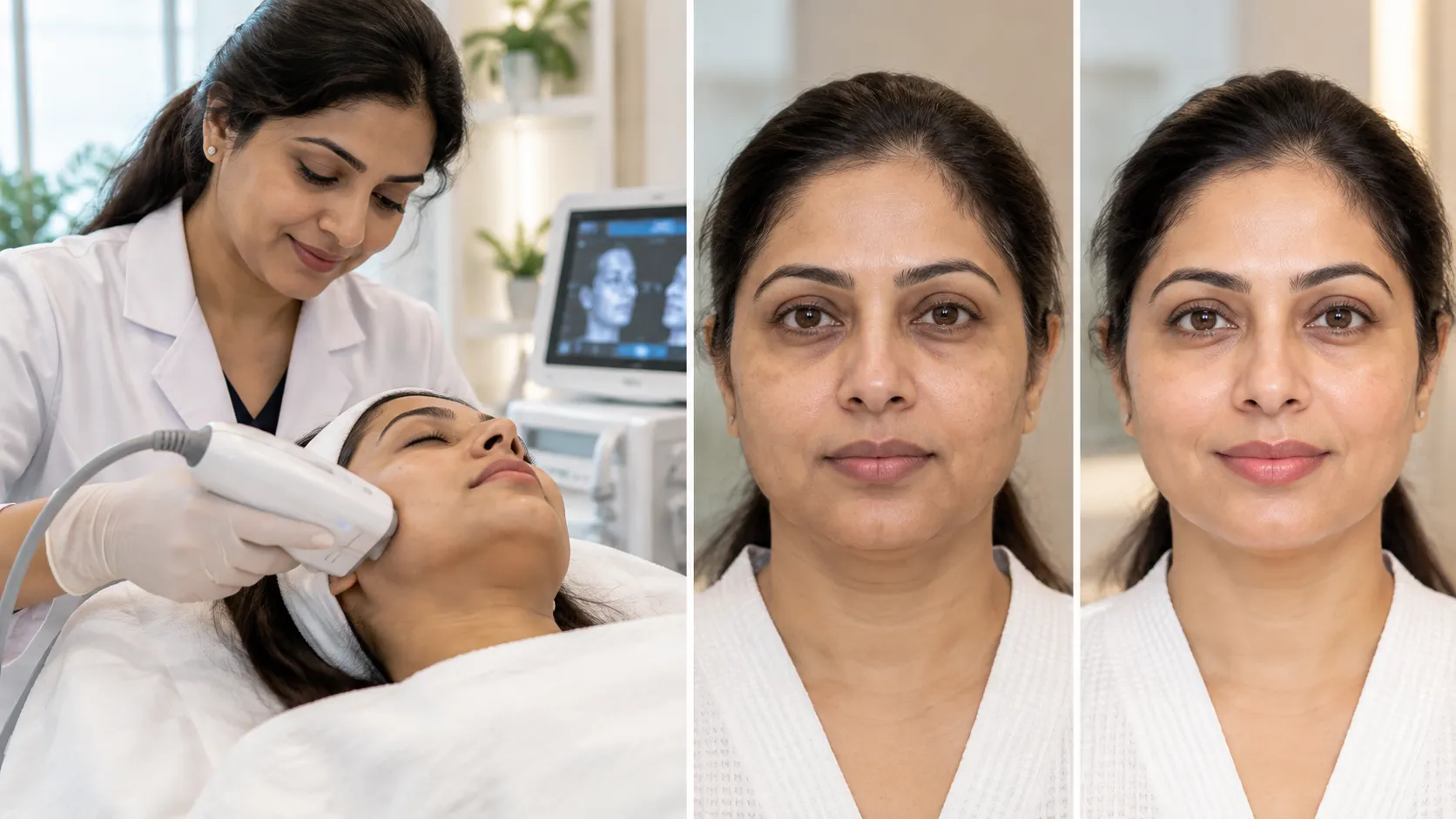
If you are researching HIFU treatment in Santacruz West, one of the most important things to understand is what a realistic before-and-after result actually looks like. HIFU, or High-Intensity Focused Ultrasound, is a non-surgical aesthetic treatment used for selected skin-tightening and lifting concerns. Clinical reviews have found evidence of improvement in facial skin laxity, particularly around areas such as the lower face and neck, but results vary between individuals and treatment protocols.
HIFU results are also not necessarily immediate. The appearance of the skin can change gradually after treatment, which is why the timing and quality of before-and-after photographs matter. This guide explains what you may realistically notice before and after HIFU, how the treatment works, when results may appear, what affects the outcome, possible side effects, cost factors and questions to ask before choosing a Skin Clinic in Santacruz West.
What Is HIFU Treatment?
HIFU stands for High-Intensity Focused Ultrasound. In aesthetic applications, focused ultrasound energy is delivered into targeted tissue to produce localized effects without surgical incisions. FDA guidance describes focused ultrasound aesthetic systems as non-invasive devices intended to create localized changes in tissue for aesthetic purposes.
Depending on the device and its intended use, focused ultrasound may be used for skin tightening, lifting-related concerns or body-contouring applications. It is important to distinguish between different HIFU devices and treatment protocols because not every system is intended for the same purpose.
For facial aesthetics, HIFU is generally considered when someone wants to address concerns related to mild to moderate skin laxity, reduced firmness or facial contour definition.
It is not a surgical facelift and should not be expected to produce an identical result.
HIFU Before and After: What Can Actually Change?
The most useful way to understand HIFU is to compare realistic changes rather than expecting a dramatic transformation.
Depending on the individual and treatment area, the goal may be an improvement in the appearance of:
- Mild skin laxity
- Skin firmness
- Lower-face definition
- Jawline appearance
- Neck skin laxity
- Certain signs of facial ageing
- Overall skin tightness
A systematic review of microfocused ultrasound found evidence of facial skin tightening, particularly in patients with mild to moderate laxity, although treatment protocols and devices varied across studies.
The amount of visible change is influenced by your starting condition, treatment area, device, treatment settings and individual response.
10 HIFU Before and After Facts You Should Know
1. HIFU Results Are Usually Gradual, Not Instant
One of the biggest misconceptions about HIFU is that the final result should be visible immediately after treatment.
You may notice some change earlier, but the final appearance should be evaluated over time. Research on microfocused ultrasound has reported improvement continuing over follow-up periods, although the exact timeline varies between studies and treatment protocols.
This means a photograph taken immediately after treatment should not automatically be considered the final HIFU result.
When comparing photographs, always ask:
When was the “after” photograph taken?
An image taken immediately after treatment tells you something different from one taken several weeks or months later.
2. Your Before-Treatment Skin Condition Matters
HIFU does not create the same result for every person.
The starting condition of your skin is an important factor.
For example, someone with mild skin laxity may notice a different degree of visible improvement compared with someone with more advanced laxity.
Relevant factors may include:
- Degree of skin laxity
- Treatment area
- Age-related changes
- Skin structure
- Facial anatomy
- Previous cosmetic procedures
- Treatment settings
- Individual response
Research suggests that HIFU/microfocused ultrasound can be useful for selected patients with mild to moderate facial laxity, while more advanced laxity may require consideration of other treatment options.
3. HIFU Is Not the Same as a Surgical Facelift
HIFU is a non-surgical treatment.
A surgical facelift involves surgical manipulation of tissue, while HIFU uses focused ultrasound energy without making surgical incisions.
Therefore, comparing a HIFU before-and-after photograph directly with a surgical facelift result can create unrealistic expectations.
HIFU may be considered by people who want a non-surgical approach to selected skin-tightening concerns, but it does not reproduce every effect of surgery.
4. HIFU Face Before and After May Show Improved Firmness
For suitable candidates, facial HIFU may be used to address areas where the skin appears less firm.
Possible areas include:
Lower Face
Treatment may be considered when mild laxity affects the lower facial contour.
Jawline
Some people seek HIFU for a less defined-looking jawline associated with skin laxity.
Neck
HIFU may also be considered for selected cases of neck skin laxity.
Brow or Upper Facial Areas
Certain focused-ultrasound systems and treatment protocols may be used for selected upper-face lifting concerns.
The appropriate treatment area depends on the device, anatomy and professional assessment.
5. HIFU Jawline Before and After Is Not the Same as Fat Removal
This distinction is particularly important.
A less defined jawline can have different causes, including:
- Skin laxity
- Facial fat distribution
- Anatomical structure
- Age-related changes
- Combination of several factors
If the primary issue is loose skin, skin tightening may be relevant. If the concern is predominantly excess fat, a skin-tightening treatment may not address the underlying issue in the same way.
Some ultrasound technologies are also used for body contouring, but their mechanisms and intended applications can differ from facial skin-tightening protocols.
A professional assessment can help determine what is actually contributing to the appearance you want to change.
6. Before-and-After Photos Need to Be Compared Properly
Before-and-after photographs can be useful, but they can also be misleading when the conditions are different.
For a meaningful comparison, try to look for photographs taken with similar:
- Camera angle
- Lighting
- Distance
- Facial expression
- Head position
- Makeup
- Background
A change in lighting or facial expression can make the face appear more or less defined.
If a clinic presents HIFU before-and-after photographs, ask about the timeframe between the two photographs and whether the images represent actual patients who received the treatment being discussed.
7. HIFU Results Can Take Weeks or Months to Evaluate
There is no single universal day when everyone sees their final result.
Different studies use different follow-up periods, and treatment protocols vary. Research has reported improvement at follow-up assessments extending beyond the first few weeks.
A practical way to think about the process is:
| Stage | What you may notice |
|---|---|
| Before treatment | Skin laxity, reduced firmness or less defined contours |
| Immediately after | Possible temporary redness, tenderness, swelling or sensitivity |
| Early recovery | Temporary treatment-related sensations may settle |
| Following weeks | Gradual aesthetic changes may become easier to evaluate |
| Later follow-up | The treatment outcome can be assessed more meaningfully |
This is a general framework rather than a guaranteed timeline.
8. One HIFU Session Does Not Guarantee the Same Result for Everyone
There is no universal number of HIFU sessions that guarantees a particular result.
Treatment plans depend on:
- The treatment area
- Degree of skin laxity
- Device being used
- Treatment settings
- Individual response
- Treatment goals
- Professional assessment
A provider should assess the individual rather than automatically recommending the same treatment schedule to everyone.
9. Temporary Side Effects Can Occur
Non-surgical does not mean completely risk-free.
Studies of microfocused ultrasound have reported temporary effects such as redness, swelling, tenderness and discomfort. Less common adverse effects have also been reported.
FDA guidance for aesthetic focused-ultrasound systems identifies potential risks including thermal injury, mechanical injury and ocular injury, emphasizing the importance of appropriate device use, testing and safety measures.
Possible short-term effects can include:
- Redness
- Swelling
- Tenderness
- Sensitivity
- Temporary discomfort
- Bruising in some cases
Rare or more significant complications have also been reported in the literature, so HIFU should not be treated as a risk-free cosmetic procedure.
If you experience a severe, unexpected or persistent reaction, contact an appropriate healthcare professional.
10. Realistic Expectations Are More Important Than Dramatic Before-and-After Photos
The most important HIFU fact is that individual results vary.
A good treatment decision should not be based only on seeing a dramatic photograph online.
Instead, consider:
- What problem are you actually trying to address?
- Is it primarily skin laxity?
- Is there significant volume or fat-related concern?
- How much improvement would realistically be possible?
- Is HIFU appropriate for your skin and treatment area?
- Are there alternative treatments worth discussing?
- What are the possible risks?
The goal should be an informed treatment plan rather than a promise of a particular appearance.
HIFU Before and After Timeline: What Should You Expect?
Understanding the timeline can make it easier to interpret results.
Before HIFU
Before treatment, a consultation should identify the concern being treated.
This may include assessing:
- Skin laxity
- Facial contour
- Treatment area
- Skin condition
- Previous procedures
- Treatment expectations
Photographs may also be taken so that changes can be assessed consistently later.
Immediately After HIFU
Some people may experience temporary redness, swelling, tenderness or sensitivity.
The immediate appearance should not necessarily be treated as the final result.
After a Few Weeks
Gradual changes may become easier to notice.
However, the exact timing varies between people and treatment protocols.
Around Later Follow-Up
A later assessment can provide a more meaningful opportunity to evaluate the outcome.
Clinical research has reported improvements at follow-up assessments extending to several months, but study protocols and devices differ.
HIFU Before and After by Treatment Area
HIFU Face Before and After
Facial HIFU is commonly considered for selected concerns involving skin laxity and firmness.
The desired outcome may be a firmer-looking facial appearance rather than a dramatic change in facial structure.
HIFU Jawline Before and After
For someone concerned about a less defined jawline, HIFU may be considered when skin laxity contributes to the appearance.
However, jawline definition can also depend on facial anatomy and fat distribution, so HIFU is not automatically appropriate for every person.
HIFU Neck Before and After
The neck can show age-related changes and skin laxity.
Selected ultrasound treatments may be used for neck tightening, but suitability depends on the degree and cause of the laxity.
HIFU Double Chin Before and After
A double chin can result from different factors.
If loose skin is the main concern, skin tightening may be considered. If excess submental fat is the main issue, a different approach may be more appropriate.
This is why an assessment is important before choosing a treatment.
Who May Consider HIFU Treatment?
HIFU may be considered by people who want a non-surgical option for selected skin-tightening concerns.
It may be worth discussing with a professional if you are concerned about:
- Mild facial skin laxity
- Reduced firmness
- Less defined lower-face contours
- Mild neck laxity
- Certain age-related skin changes
Research has generally found the strongest evidence in selected patients with mild to moderate facial laxity.
That does not mean HIFU is appropriate for everyone.
Who May Need a Different Treatment Approach?
HIFU may not address the underlying cause of every cosmetic concern.
You may need a different or additional approach if your primary concern is:
- Significant excess skin
- Substantial facial volume loss
- Predominantly excess fat
- Deep acne scarring
- Pigmentation
- Active skin disease
- A concern requiring surgical correction
This is one reason why consultation matters.
A treatment should match the problem rather than selecting a procedure simply because it is popular.
What Are the Risks and Side Effects of HIFU?
HIFU uses concentrated ultrasound energy, so correct device use and treatment technique matter.
The FDA identifies potential risks for aesthetic focused-ultrasound systems including thermal damage, mechanical injury and ocular injury.
Reported treatment-related effects can include:
- Temporary redness
- Swelling
- Pain or discomfort
- Tenderness
- Bruising
- Temporary sensory changes
More significant complications have been reported less frequently in the literature.
This is why treatment should involve appropriate assessment, correct treatment planning and careful use of the specific device.
If you have an open wound, active skin lesion, an implant or another medical condition that could affect treatment suitability, discuss it with your healthcare professional before proceeding. Device-specific contraindications can differ, and FDA guidance identifies several conditions that require particular caution.
What Should You Do Before HIFU Treatment?
Before booking HIFU, discuss the following during your consultation:
1. Your Main Concern
Explain exactly what you want to improve.
2. The Treatment Area
Ask whether your concern is actually suitable for HIFU.
3. Expected Results
Ask what degree of improvement is realistic rather than asking for a guaranteed outcome.
4. Treatment Technology
Ask which HIFU or focused-ultrasound system will be used and what it is intended to treat.
5. Potential Risks
Ask about common and less common side effects.
6. Alternatives
Find out whether another treatment could be more appropriate for your specific concern.
7. Follow-Up
Ask when your result should be assessed and what aftercare is recommended.
HIFU Aftercare: What Should You Know?
Aftercare depends on the specific treatment and device.
Your provider may give instructions regarding:
- Skin care
- Cleansing
- Sun exposure
- Exercise
- Heat exposure
- Cosmetic products
- Other aesthetic treatments
Follow the instructions provided for your specific procedure rather than relying only on generic online recommendations.
If you develop unexpected or worsening symptoms, contact your healthcare provider.
How Much Does HIFU Treatment Cost in Santacruz West?
There is no single price that applies to every HIFU treatment.
The cost may depend on:
- Treatment area
- Size of the treatment area
- Device and technology used
- Number of treatment lines or passes
- Treatment settings
- Number of sessions recommended
- Whether multiple areas are treated
- Consultation and follow-up requirements
For this reason, a clinic should provide pricing based on the actual treatment plan rather than relying on a generic price.
If you are comparing HIFU treatment in Santacruz West, ask exactly what is included in the quoted cost.
HIFU vs RF Skin Tightening
HIFU and radiofrequency treatments both use energy to create controlled effects in tissue, but they use different forms of energy and may target tissue differently.
| Factor | HIFU | RF |
|---|---|---|
| Energy | Focused ultrasound | Radiofrequency |
| Common aesthetic use | Selected skin-tightening/lifting concerns | Skin tightening and skin-quality concerns |
| Treatment approach | Focused energy at selected depths | Radiofrequency heating |
| Suitability | Depends on concern and device | Depends on concern and device |
| Results | Individual and gradual | Individual and treatment-dependent |
Neither should automatically be considered the right choice for everyone. A professional assessment can help determine which approach matches the specific concern.
A recent systematic review also found that HIFU appears promising for skin laxity while noting the need for better standardization and further research.
HIFU vs Surgical Facelift
These are fundamentally different procedures.
HIFU:
- Non-surgical
- No surgical incision
- Uses focused ultrasound energy
- Generally intended for selected degrees of skin laxity
Surgical facelift:
- Surgical procedure
- Involves repositioning and/or removing tissue
- Designed for more substantial structural changes
HIFU should therefore not be marketed or understood as producing the same result as a surgical facelift.
How to Choose a Skin Clinic in Santacruz West for HIFU
If you are searching for a Skin Clinic in Santacruz West, don’t make the decision based only on photographs or promotional claims.
Before treatment, consider asking:
- What specific concern will HIFU address?
- What technology will be used?
- Who will perform the procedure?
- What results are realistic?
- What are the potential side effects?
- How long should results take to develop?
- What happens if HIFU is not suitable for my concern?
- Are there alternative treatment options?
- What follow-up is provided?
A consultation should give you enough information to make an informed decision without promising a guaranteed outcome.
Common Mistakes People Make Before HIFU
Expecting an Immediate Final Result
HIFU results can develop gradually, so immediate appearance is not necessarily the final outcome.
Comparing Yourself With Edited Photos
Lighting, angles, makeup and image editing can significantly change how skin appears.
Assuming Everyone Gets the Same Result
Individual anatomy, skin condition and treatment response differ.
Choosing Based Only on Price
A low price does not tell you whether the treatment is appropriate for your concern or whether the treatment plan is suitable.
Assuming HIFU Treats Every Ageing Concern
Skin laxity, pigmentation, acne scars, wrinkles, volume loss and excess fat can have different underlying causes.
Ignoring the Device Being Used
“HIFU” is a broad term. Different systems and protocols may have different indications and treatment characteristics.
How to Judge HIFU Before and After Photos
When looking at results online, use a simple checklist.
Check 1: Same Person
Make sure the before and after images actually represent the same individual.
Check 2: Same Angle
The face should be positioned similarly.
Check 3: Similar Lighting
Different lighting can make contours appear dramatically different.
Check 4: Know the Time Gap
A result immediately after treatment is different from one assessed later.
Check 5: Look at the Entire Treatment Area
Don’t judge only one facial feature.
Check 6: Ask Whether the Image Is Authentic
If a clinic uses before-and-after photographs, ask whether they are genuine patient photographs and whether permission has been obtained for their use.
FAQs:
How long does HIFU take to show results?
HIFU results are generally gradual. Some changes may appear earlier, while further improvement may become more noticeable during later follow-up. The exact timing varies according to the treatment and individual response.
Does HIFU really tighten the skin?
Clinical research supports the potential of focused ultrasound to improve skin tightening in selected patients, particularly those with mild to moderate facial laxity. However, results vary and further standardization of treatment protocols is still needed.
What does HIFU look like after one month?
The appearance after one month varies between individuals. Some people may notice gradual improvement, while others may require a longer period before the result is easier to assess.
How long does HIFU last?
The duration of visible results varies. Natural ageing continues after treatment, and available long-term evidence is still limited for some treatment protocols.
Is HIFU painful?
The experience varies. Studies of microfocused ultrasound have reported moderate discomfort in some patients, along with temporary treatment-related effects such as redness, swelling and tenderness.
Can HIFU remove a double chin?
It depends on what is causing the appearance of the double chin. HIFU used for skin tightening may address lax skin, but it should not automatically be considered a treatment for every type of submental fat or double chin.
How many HIFU sessions are needed?
There is no universal number. The treatment plan depends on the treatment area, device, skin condition, treatment goals and individual assessment.
Is HIFU suitable for everyone?
No. Suitability depends on individual circumstances, the treatment area, the specific device and the concern being treated. A professional assessment is appropriate before treatment.
Final Thoughts on HIFU Before and After Results
The most useful way to evaluate HIFU before and after results is to look beyond dramatic photographs. HIFU can provide meaningful improvement for appropriately selected skin-tightening concerns, but results are individual and should be assessed over time. Research supports its potential for improving facial skin laxity, while also highlighting differences between treatment protocols and the need for further standardized research.
If you are considering HIFU treatment in Santacruz West, start by identifying the specific concern you want to address. Then discuss your skin condition, realistic expectations, treatment technology, possible risks, cost and alternative options with a qualified professional.
A consultation at Archanawellness can be used to discuss your individual skin-tightening goals and determine whether HIFU is an appropriate treatment option for you.