What Is Acne Scar Treatment?
Acne scar treatment refers to medical procedures used to improve the appearance of scars left after acne.
These scars may look like small holes, dents, uneven patches or raised areas. They often appear on the cheeks, temples, forehead, jawline and sometimes the back.
If you’re searching for Acne Scar Treatment in Mumbai, the first thing to know is that there isn’t one treatment that works for every scar.
A shallow rolling scar needs a different approach from a narrow ice-pick scar. Deep boxcar scars may also need a different combination.
The goal isn’t always to make every scar disappear completely. The realistic goal is to make scars less visible, smoother and more blended with the surrounding skin.
The American Academy of Dermatology notes that depressed acne scars may be treated with options such as chemical peels, fillers, lasers, microneedling, radiofrequency, PRP and scar surgery. A dermatologist may combine treatments when appropriate.
Why Do Acne Scars Become Pitted or Deep?
Acne scars develop when inflammation damages the deeper layers of the skin.
Severe inflammatory acne, especially nodules and cysts, has a higher risk of leaving scars. Picking or squeezing acne can increase the chance of permanent scarring.
Think of your skin like a mattress.
If the supporting structure underneath gets damaged, the surface can sink in. A similar process can create depressed acne scars.
Some scars also become tethered to deeper tissue by fibrous bands. This is particularly relevant to rolling scars.
That is why simply exfoliating the surface may not correct a deep indentation.
Types of Acne Scars You May Have
Understanding your scar type is one of the most important steps before choosing treatment.
1. Ice-Pick Scars
Ice-pick scars are narrow and deep.
They look like tiny holes that extend deeper into the skin. They can be difficult to treat with surface-level procedures alone.
TCA CROSS is one procedure sometimes used specifically for atrophic acne scars such as ice-pick scars.
2. Boxcar Scars
Boxcar scars are wider depressions with more clearly defined edges.
They may be shallow or deep and can occur on the cheeks and temples.
Depending on their depth, treatment may involve resurfacing, microneedling, laser treatment, fillers or other procedures.
3. Rolling Scars
Rolling scars create a wavy or uneven appearance.
They often result from fibrous bands pulling the skin downward.
Subcision may be considered for suitable rolling or tethered depressed scars because it releases these fibrous connections under the skin.
4. Raised Acne Scars
Not every acne scar is a depression.
Some scars become raised because the body produces excess collagen during healing. These include hypertrophic scars and keloids.
They need a different treatment strategy from pitted acne scars.
Acne Marks vs Acne Scars: What’s the Difference?
This is one of the most common questions people ask.
A dark or red mark left after acne isn’t necessarily a true scar.
Post-inflammatory hyperpigmentation can look brown or grey, while post-inflammatory erythema can appear red or pink.
A true acne scar usually involves a change in the skin’s texture or structure.
For example:
Flat dark mark: usually pigmentation.
Red flat mark: usually post-inflammatory redness.
Small depression: likely an atrophic scar.
Deep narrow hole: may be an ice-pick scar.
Wide indentation: may be a boxcar or rolling scar.
This distinction matters because pigmentation-focused treatments may not correct a deep indentation.
What Is the Best Acne Scar Treatment in Mumbai?
There isn’t a single “best” treatment for everyone.
The right acne scar treatment depends on:
- Scar type
- Scar depth
- Skin tone
- Active acne
- Previous treatments
- Skin sensitivity
- Downtime you can manage
- Your expected outcome
- Budget
- Whether pigmentation is also present
DermNet recommends an individualized approach based on the scar’s size, depth, location, skin type, goals and other factors. Combination treatment can be useful when scars have different characteristics.
For example, someone with rolling scars and a few deep ice-pick scars may not benefit from treating the entire face with one procedure.
A targeted approach may make more sense.
Microneedling for Acne Scars
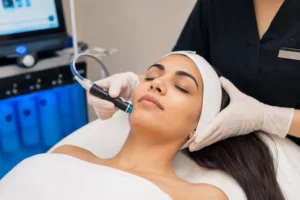
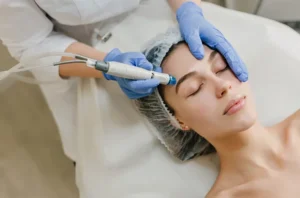
Microneedling, also called collagen induction therapy, uses very small needles to create controlled micro-injuries in the skin.
The healing process encourages collagen production.
Over time, this can improve uneven texture and make some depressed acne scars less noticeable.
The American Academy of Dermatology describes microneedling as a minimally invasive treatment that can improve acne scars and is considered suitable for all skin tones when properly performed.
Microneedling may be particularly useful for:
- Mild to moderate depressed scars
- Uneven skin texture
- Shallow boxcar scars
- General acne scar texture
- Enlarged-looking pores associated with uneven texture
However, deep scars may need more than microneedling alone.
Multiple sessions are commonly needed, and improvement continues as collagen remodeling takes place.
RF Microneedling for Pitted Acne Scars
RF microneedling combines microneedling with radiofrequency energy.
Tiny needles create controlled channels while radiofrequency energy delivers heat into selected skin layers.
The aim is to stimulate collagen remodeling at different depths.
The American Academy of Dermatology notes that radiofrequency microneedling can make acne scars less noticeable and may be used as part of an individualized treatment plan.
It may be considered when the main concern is:
- Pitted acne scars
- Uneven skin texture
- Mild to moderate depressed scars
- Enlarged-looking pores
- Loss of skin firmness around scars
The settings should be selected according to the person’s skin, scar pattern and treatment goal.
This is especially important for people with darker Indian skin, where excessive inflammation can sometimes trigger pigmentation.
Laser Treatment for Acne Scars
Laser resurfacing is another option for acne scar correction.
Depending on the laser, treatment can stimulate collagen, remodel scar tissue or improve the transition between scars and normal skin.
Fractional laser treatments are commonly discussed for depressed acne scars.
However, “laser treatment” isn’t one single procedure. Different devices work differently.
Your skin tone, scar depth and risk of pigmentation should influence the choice.
Laser treatment may be useful for:
- Uneven texture
- Shallow depressed scars
- Boxcar scars
- Overall scar blending
- Certain pigmentation or redness concerns
The American Academy of Dermatology explains that laser resurfacing can stimulate collagen and elastin and may help reduce the appearance of depressed acne scars.
Laser treatment can also involve downtime, redness and temporary skin changes.
For that reason, choosing the device should come after assessing the skin rather than before.
Chemical Peels and TCA CROSS
Chemical peels use controlled chemical exfoliation to improve selected skin concerns.
Some superficial or medium-depth peels may improve skin texture and pigmentation.
TCA CROSS is different from a conventional full-face peel.
It involves applying a high-concentration trichloroacetic acid solution directly into selected atrophic scars. The controlled injury is intended to stimulate new collagen formation.
It is commonly considered for certain ice-pick scars.
However, TCA CROSS doesn’t usually make deep scars disappear completely. DermNet notes that complete resolution is unlikely with TCA CROSS alone, and combination treatment may sometimes provide better results.
This is also not a procedure to experiment with at home.
High-strength acids can cause burns, pigmentation and additional scarring if used incorrectly.
Subcision for Rolling and Depressed Acne Scars
Some acne scars aren’t simply “missing collagen.”
They are physically attached to deeper tissue.
This is where subcision for acne scars may be considered.
During subcision, a trained clinician uses a needle or appropriate instrument beneath the scar to release fibrous bands pulling the skin downward.
Once the tethering is released, the depressed area can become less indented.
Subcision is particularly associated with depressed, bound-down scars and rolling scars. Deep ice-pick scars generally require a different approach.
Depending on the scar pattern, subcision may be combined with other procedures.
Dermal Fillers for Deep Acne Scars
Some depressed acne scars respond to volume restoration.
A dermal filler can be placed beneath selected depressed scars to raise them closer to the surrounding skin.
Fillers aren’t suitable for every scar.
They may be considered when there is a noticeable depression that responds to lifting or volume correction.
The AAD notes that fillers can add volume to depressed scars, although different fillers have different durations and may require maintenance.
A consultation is important because injecting the wrong type of scar may not produce the expected result.
PRP and Combination Acne Scar Treatment
PRP, or platelet-rich plasma, is sometimes used alongside procedures such as microneedling.
The concept is to use concentrated platelets from the patient’s own blood as an adjunct to another procedure.
The AAD notes that PRP may be used with procedures such as microneedling and that studies have reported improvement when PRP is combined with scar treatment.
The bigger lesson is that combination treatment isn’t automatically better.
It should be chosen because the combination addresses a specific problem.
For example:
Rolling scars + tethering: subcision may be considered.
Ice-pick scars: TCA CROSS or targeted techniques may be considered.
Texture: microneedling or resurfacing may be considered.
Depressed scars: fillers may sometimes help.
Mixed scars: a combination approach may be more appropriate.
How Is the Right Acne Scar Treatment Chosen?
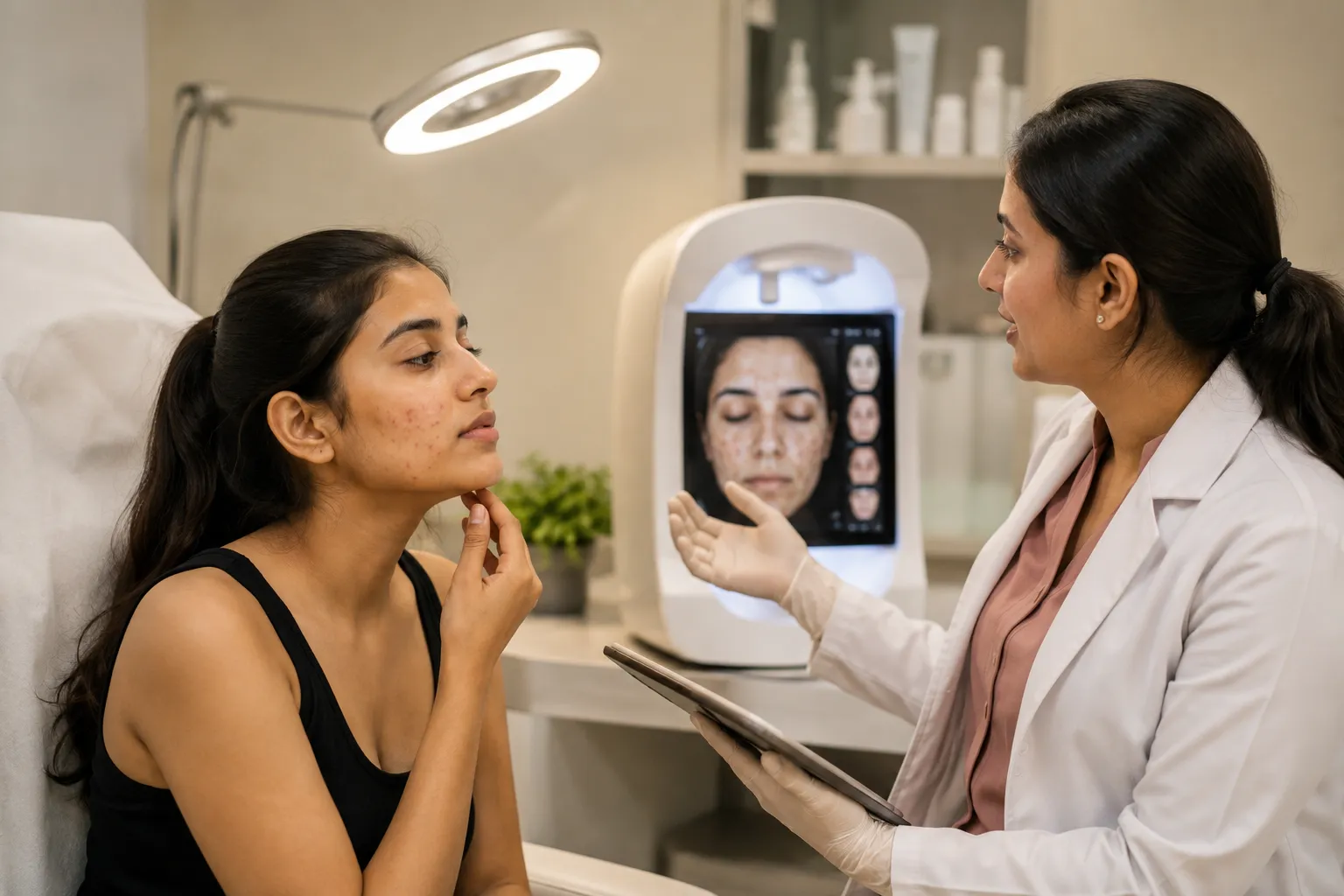
A proper consultation should begin with an assessment rather than immediately selecting a procedure.
Step 1: Check for Active Acne
If you still have frequent inflamed acne, that needs attention.
Treating scars while new inflammatory acne continues can be counterproductive.
DermNet specifically recommends treating active acne before starting scar management.
Step 2: Identify the Scar Type
The clinician examines:
- Depth
- Width
- Shape
- Location
- Skin texture
- Pigmentation
- Tethering
- Raised areas
Step 3: Assess Your Skin Type
Indian skin can develop post-inflammatory pigmentation after inflammation.
Treatment intensity should therefore be selected carefully.
Step 4: Discuss Your Goal
There’s a big difference between:
“I want completely clear skin.”
and
“I want my scars to be less noticeable in normal lighting.”
A realistic goal helps create a safer and more useful treatment plan.
What to Expect During Acne Scar Treatment
Your experience depends on the procedure.
For microneedling, the skin may look red for a short period. Mild swelling or sensitivity can also occur.
Laser procedures may involve more downtime depending on the technology and intensity.
Subcision can cause temporary swelling or bruising.
Chemical procedures may cause redness, peeling or temporary changes in pigmentation.
Your clinician should explain:
- Preparation
- Procedure steps
- Expected downtime
- Skin-care restrictions
- Sun protection
- Warning signs
- Follow-up schedule
Don’t judge the final result too quickly.
Collagen remodeling takes time.
DermNet notes that improvement after skin needling can continue for months as the skin remodels.
How Many Acne Scar Treatment Sessions Are Needed?
There is no universal number.
Some people see visible improvement after one session, while others need several sessions.
The number depends on:
- Scar depth
- Number of scars
- Skin response
- Treatment selected
- Whether combination treatment is used
- How well aftercare is followed
Deep scars generally require more patience than mild texture changes.
A useful consultation should focus on expected improvement, not an unrealistic promise of complete scar removal.
Acne Scar Treatment Cost in Mumbai
The acne scar treatment cost in Mumbai varies widely.
There isn’t one fixed price because different procedures have different requirements.
The final cost may depend on:
- Treatment type
- Technology used
- Number of sessions
- Area being treated
- Scar severity
- Whether combination procedures are needed
- Follow-up requirements
A single shallow scar may require a different approach from extensive deep scarring across both cheeks.
For this reason, online prices should be treated as general estimates rather than a final quote.
The better question is not simply, “How much is one session?”
Ask:
“What treatment plan is appropriate for my scar type, and how many sessions might I realistically need?”
Common Mistakes That Can Make Acne Scars Worse
Picking Active Acne
Squeezing pimples can increase inflammation and trauma.
That can increase the chance of scarring.
Using Strong Acids Without Guidance
High-strength chemical products aren’t automatically better.
Incorrect use can cause burns and pigmentation.
Choosing a Treatment Because It’s Trending
A popular treatment may not be the right treatment for your scar.
Your scar structure matters more than the trend.
Expecting One Session to Remove Deep Scars
Deep acne scars often require staged treatment.
Collagen remodeling also takes time.
Ignoring Sunscreen
Sun exposure can worsen pigmentation and make post-treatment discoloration more noticeable.
Sun protection is an important part of scar care.
Treating Active Acne as an Afterthought
New acne can create new scars.
Controlling active breakouts should remain part of the overall strategy.
Can Skincare Remove Deep Acne Scars?
Skincare can support healthier skin, but deep structural scars usually cannot be completely removed with creams alone.
Ingredients such as retinoids, salicylic acid and other actives may help with acne, pigmentation or overall skin texture.
But a deep depression is a structural change.
Think about it this way:
A cream can improve the surface.
A deep scar may require a procedure that reaches the underlying scar tissue.
That doesn’t mean skincare is useless.
A good home routine can help control acne, protect the skin and support results after professional treatment.
Real-Life Example: Why One Treatment Doesn’t Always Fit Every Scar
Imagine someone has been dealing with acne scars since college.
The cheeks have rolling depressions, while a few small ice-pick scars remain near the temples. There are also brown marks from previous acne.
Choosing one treatment for the entire face may not address all three concerns equally.
The rolling scars may need a treatment that releases tethering.
The ice-pick scars may need targeted treatment.
The pigmentation may require a separate skin-care strategy.
This is why a personalized acne scar treatment plan can make more sense than choosing a procedure simply because it is advertised as the “best.”
Expert Tips for Better Acne Scar Results
1. Treat Active Acne First
New breakouts can create new scars.
2. Don’t Compare Your Skin to Social Media Photos
Lighting, makeup, camera angles and editing can dramatically change how scars look.
3. Take Photos in Consistent Lighting
This helps you judge gradual progress more fairly.
4. Give Collagen Time
Many scar treatments work through gradual remodeling.
5. Protect Your Skin From the Sun
Use broad-spectrum sunscreen as advised by your skincare professional.
6. Don’t Combine Procedures Yourself
Professional procedures should be planned around each other.
7. Tell Your Clinician About Previous Treatments
Previous lasers, peels, isotretinoin use and other procedures may affect treatment planning.
8. Ask About Downtime
A treatment that sounds effective may not suit your schedule.
9. Ask What Happens If Pigmentation Develops
This is especially useful if you’re prone to dark marks after acne.
10. Focus on Improvement, Not Perfection
Good acne scar treatment aims to make scars less noticeable and improve skin texture.
People Also Ask About Acne Scar Treatment
Can pitted acne scars be completely removed?
Usually, treatment aims to reduce their appearance rather than guarantee complete removal. The result depends on scar type, depth, skin characteristics and treatment response.
What is the best treatment for deep acne scars?
There isn’t one universal treatment. Deep scars may require targeted procedures such as subcision, TCA CROSS, resurfacing, fillers or combinations depending on the scar type.
Does microneedling remove acne scars?
Microneedling can improve the appearance of some acne scars by stimulating collagen. It may be less suitable as a standalone option for very deep or strongly tethered scars.
Is laser treatment good for acne scars?
Laser resurfacing can improve certain depressed scars and uneven texture. The appropriate laser depends on the scar pattern and skin characteristics.
Is subcision good for rolling acne scars?
Subcision can be useful for suitable rolling and bound-down depressed scars because it releases fibrous bands underneath the scar.
What is TCA CROSS used for?
TCA CROSS is a targeted chemical technique commonly used for selected atrophic acne scars, especially ice-pick scars.
How many sessions are required for acne scars?
The number varies. Mild scars may need fewer sessions, while deep or mixed scars can require a longer treatment plan.
Can acne scar creams remove pitted scars?
Creams may support acne control, pigmentation and skin quality, but deep pitted scars usually involve structural changes that topical skincare alone may not correct.
Is acne scar treatment safe for Indian skin?
Many treatments can be performed safely on Indian skin when appropriately selected and performed. However, the risk of post-inflammatory pigmentation should be considered when planning procedures.
When should I start acne scar treatment?
Ideally, active acne should be reasonably controlled before starting scar-focused procedures. A consultation can help determine when you’re ready.
Why Choose a Personalized Approach at Archana Wellness?
If you’re looking for Acne Scar Treatment in Mumbai, start with an assessment rather than choosing a procedure from an online list.
At Archana Wellness, the focus should be on understanding what is actually creating the uneven appearance of your skin.
Are the scars rolling?
Are they deep and narrow?
Are they boxcar-shaped?
Is pigmentation making them look more noticeable?
Or are several types present together?
These questions matter because the right treatment depends on the problem being treated.
A professional assessment can help determine whether options such as microneedling, RF microneedling, chemical peels, laser resurfacing, subcision, PRP or combination treatment are appropriate for your skin.
The aim should always be a realistic improvement in texture and appearance, with treatment selected according to your individual needs.
What’s the Right Acne Scar Treatment for Your Skin?
Acne scars can be frustrating, especially when the acne itself has already disappeared.
But pitted and deep scars aren’t all the same.
Ice-pick scars, rolling scars and boxcar scars have different structures. That’s why the best acne scar treatment depends on identifying the scar correctly before selecting a procedure.
Microneedling may help improve texture and stimulate collagen. RF microneedling can combine controlled needling with radiofrequency energy. Laser resurfacing may help selected depressed scars. TCA CROSS can be useful for certain ice-pick scars, while subcision may help scars that are tethered underneath the skin. Fillers and combination treatments may also have a role in selected cases.
The important point is simple: don’t choose the treatment first and diagnose the scar later.
Get the scar assessed first.
A thoughtful treatment plan can then target the actual cause of the uneven texture while considering your skin type, downtime, expectations and long-term skin health.
Looking for Acne Scar Treatment in Mumbai?
If pitted, deep or uneven acne scars are affecting your confidence, Archana Wellness can help you understand your treatment options.
Book a consultation to assess your acne scars and discuss a personalized treatment approach.
Archana Wellness
📍 Santacruz West, Mumbai
📞 Call or WhatsApp: +91-8104891397 | +91-9324035744 | +91-9321306966
Start with the right diagnosis, choose the right treatment, and give your skin time to improve.